From the heart of the Pacific Ocean rises a land forged by the planet's most primal forces. Hawaii, an archipelago of breathtaking beauty, is a stage where two of Earth's most powerful elements—fire and water—engage in a perpetual, dramatic dance. The volcanic fury that births the islands meets the relentless energy of the surrounding sea, creating a narrative of creation, destruction, and resilience that is written into the very landscape.
The story begins deep beneath the ocean's surface, at a hotspot—a fixed plume of exceptionally hot rock rising from the Earth's mantle. As the Pacific tectonic plate slowly drifts northwestward over this stationary furnace, the hotspot periodically punches through the crust, giving birth to volcanoes. This is how the Hawaiian-Emperor seamount chain was formed, with the Big Island of Hawaii currently sitting directly over the hotspot, home to the most active volcanoes on the planet. Kīlauea and Mauna Loa are not merely mountains; they are the live, breathing heart of the island, constantly adding new land to its shores.
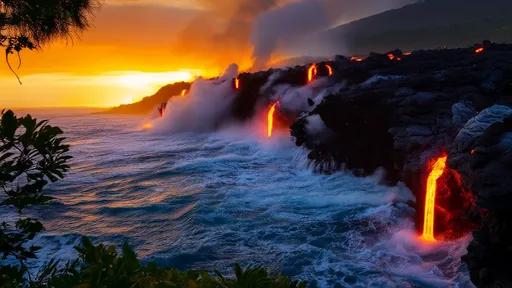
Witnessing a volcanic eruption in Hawaii is to observe the raw process of planetary creation. It is not always a cataclysmic explosion of ash and rock, though it can be. More often, it is a relentless, mesmerizing outpouring of molten rock, or lava. The lava emerges from fissures and vents, a river of incandescent orange and red that glows with an inner fire. As it flows, its surface cools into a dark, crusty shell, while the liquid rock beneath continues to move, creating the distinctive pāhoehoe lava with its smooth, ropy surface, or the rough, jagged clinkers of ‘a‘ā lava. When these fiery rivers reach the ocean, the dance reaches its crescendo.
The meeting of lava and seawater is one of the most spectacular and violent interactions on Earth. As the molten rock, which can exceed 2,100 degrees Fahrenheit, pours into the cool ocean, the result is a massive, billowing plume of steam, acid, and fine volcanic glass particles known as "laze". The rapid cooling causes the lava to shatter, building new land in the form of deltas of black sand and rugged new coastline. This is the archipelago actively growing, expanding its territory foot by foot against the immense power of the Pacific. The sound is a continuous, deafening hiss and crackle, a testament to the immense transfer of energy, and the new land formed is fragile, often collapsing under its own weight back into the sea, only to be rebuilt again by the next flow.
While the volcanoes build the land from below, the ocean shapes it from all sides. The North Shore of O‘ahu, the windward coasts of Maui and Kaua‘i—these are places where the full, untamed power of the Pacific is on display. The waves that crash upon these shores are born from storms thousands of miles away. Their energy travels unimpeded across the deep ocean, finally releasing its fury upon the Hawaiian Islands. In the winter, swells generated by North Pacific storms create the legendary, towering waves of Waimea Bay and Jaws, waves that can reach over 50 feet in height, drawing surfers and spectators from around the globe.
This constant assault by the waves is a master sculptor at work. It carves sheer sea cliffs into the sides of ancient volcanoes, like the majestic Nā Pali Coast of Kaua‘i. It grinds down volcanic rock into the famous black, green, and even rare red sands that color Hawaii's beaches. It blasts out sea arches and creates vast underwater caverns. The ocean is the great eroder, constantly working to wear down what the volcanoes have built. This interplay is the cycle of the islands: the relentless, slow-motion battle between the constructive force of volcanism and the destructive, yet equally creative, force of erosion.
The relationship between the volcanoes and the waves is not merely one of opposition; it is also one of profound influence. The shape of the seafloor around the islands, formed by countless millennia of volcanic activity, directly dictates the behavior of the waves. Submerged volcanic ridges can focus wave energy, creating perfect, barreling surf breaks like Pipeline on O‘ahu's North Shore. Conversely, the same volcanic topography can create calm, sheltered bays ideal for the growth of coral reefs. These reefs, in turn, act as natural breakwaters, protecting the shoreline from the full force of the ocean and fostering the vibrant marine ecosystems for which Hawaii is renowned.
This dynamic environment has forced its inhabitants, both human and non-human, to adapt in remarkable ways. The native Hawaiian culture is deeply intertwined with these forces. Pele, the goddess of fire, lightning, wind, and volcanoes, is a central and revered figure. She is seen as both a creator and destroyer, her moods dictating the flow of lava. Chants and stories speak of her constant movement and her battles with her sister, the sea goddess Nāmaka. This mythology is not mere folklore; it is a sophisticated understanding of the natural world, personifying the very real geological processes that shape their home.
The flora and fauna of Hawaii are a testament to life's tenacity. Species like the ‘Ōhi‘a lehua tree are among the first to colonize fresh lava flows, their roots breaking down the rock to create soil. Endemic birds and insects have evolved to thrive in ecosystems ranging from barren lava fields to lush, wave-drenched cliffs. However, this specialization also makes them incredibly vulnerable. A single volcanic gas plume or a tsunami generated by an undersea landslide can have devastating consequences for species found nowhere else on Earth.
In the modern era, the dance between volcano and wave presents both profound challenges and unique opportunities. Tsunamis, often generated by distant earthquakes but amplified by the unique underwater topography of the island chain, remain a deadly threat. Vog, the volcanic smog from Kīlauea, can blanket islands downwind, affecting air quality and agriculture. Coastal development must constantly contend with both lava flows and coastal erosion. Yet, this very volatility is also a source of immense value. The geothermal energy from the volcanoes provides a significant portion of the Big Island's power. The dramatic landscapes, born from this elemental conflict, are the foundation of Hawaii's tourism economy, drawing millions who wish to witness this powerful natural drama firsthand.
Standing on the newest black sand beach at Puna, feeling the steam from the lava meeting the sea, or watching the winter swell thunder against the cliffs of Moloka‘i, one is struck by the sheer scale of time and power at work. The Hawaiian Islands are not a static paradise; they are a living, breathing, and ever-changing entity. The volcanoes continue to build, and the waves continue to sculpt. It is a dance that began millions of years ago with the birth of the first island, and it will continue for millions more, long after the current islands have eroded back into the sea and the hotspot has given birth to new lands to the southeast. This is the eternal conversation between fire and water, a dialogue of creation and destruction that is the true, beating heart of Hawaii.
By /Nov 7, 2025

By /Aug 4, 2025
By /Nov 7, 2025
By /Nov 7, 2025
By /Nov 7, 2025
By /Aug 4, 2025
By /Nov 7, 2025
By /Nov 7, 2025
By /Nov 7, 2025
By /Nov 7, 2025
By /Nov 7, 2025
By /Nov 7, 2025
By /Nov 7, 2025
By /Nov 7, 2025
By /Nov 7, 2025
By /Aug 4, 2025
By /Nov 7, 2025
By /Nov 7, 2025
By /Aug 4, 2025

By /Nov 7, 2025
