Beneath the sprawling wilderness of Yellowstone National Park lies one of Earth's most dynamic and volatile landscapes. The park's geothermal wonders represent a fragile interface between our world and the planet's molten heart, creating a living laboratory that has fascinated scientists and visitors for generations. These thermal features are not mere curiosities but vital components of a complex ecological system that continues to shape our understanding of geology, biology, and planetary science.
The foundation of Yellowstone's geothermal activity rests upon the Yellowstone Caldera, a massive volcanic system that last erupted approximately 640,000 years ago. This supervolcano continues to fuel the park's thermal features through an immense magma chamber located just a few miles beneath the surface. The heat from this chamber interacts with groundwater that percolates downward through fractures in the bedrock, creating the spectacular displays that define Yellowstone's character. This geothermal system operates on a scale unmatched anywhere else on Earth, with thermal features distributed across nearly 10,000 individual sites throughout the park.
Old Faithful remains the most iconic of Yellowstone's geysers, though its predictability has become less reliable in recent decades. What makes this geyser particularly fascinating is not just its regularity but the complex plumbing system that governs its eruptions. The constricted conduit through which water and steam must travel creates pressure that builds until it can no longer be contained, resulting in the spectacular displays that draw thousands of visitors daily. The intervals between eruptions have gradually lengthened over the past sixty years, possibly due to geological changes or subtle shifts in groundwater patterns, providing scientists with valuable data about the dynamic nature of hydrothermal systems.
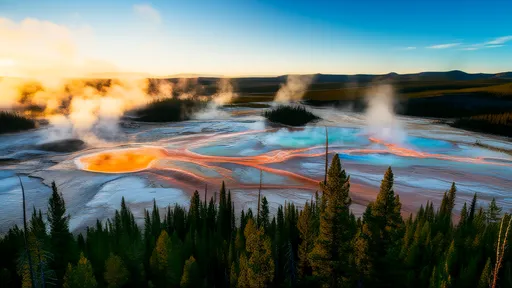
Beyond the famous geysers, Yellowstone's hot springs present an equally compelling story of geological forces and biological adaptation. The Grand Prismatic Spring exemplifies this intersection, with its vibrant colors created by heat-loving microorganisms called thermophiles. These extremophiles form complex microbial mats that change color based on the water temperature and light conditions, creating the spring's characteristic rainbow appearance. The center of the spring, where temperatures can exceed 160°F, appears deep blue because the water is too hot to support most life forms, allowing the natural color of pure water to dominate.
The Norris Geyser Basin stands as Yellowstone's most dynamic and unpredictable thermal area. This region contains some of the hottest and most acidic features in the park, with temperatures regularly measured above 400°F just below the surface. The basin's constant state of flux means that new features can appear overnight while established ones may become dormant without warning. This volatility provides scientists with crucial insights into how hydrothermal systems evolve and respond to changes in underlying geological conditions. The extreme acidity of some features creates environments that push the boundaries of what scientists previously believed could support life.
Mammoth Hot Springs presents a completely different type of thermal feature, where hot water rising through limestone deposits creates spectacular terraces of travertine. The water dissolves calcium carbonate from the limestone bedrock and deposits it at the surface as the water cools and degasses, building formations that can grow several inches per year. These constantly evolving structures create a landscape that appears almost alien, with steaming water flowing over white and orange terraces that change shape and color with the seasons. The vibrant hues come from thermophiles that have adapted to the unique chemical composition of the water.
Yellowstone's geothermal features face numerous threats that require careful management and ongoing research. The delicate bacterial mats surrounding hot springs can be destroyed by a single footstep, with damage that may take decades to heal. Changes in groundwater patterns due to climate change, seismic activity, and human development around the park's boundaries all potentially impact the hydrothermal systems. Park managers must balance public access with preservation, ensuring that future generations can experience these wonders while protecting the fragile ecosystems they support.
The study of Yellowstone's thermal features has yielded discoveries with implications far beyond the park's boundaries. Thermophilic microorganisms from Yellowstone have revolutionized molecular biology, providing heat-stable enzymes that made PCR technology possible. These discoveries have opened new frontiers in biotechnology and our understanding of how life can adapt to extreme conditions. The research continues to inform the search for life on other planets, as scientists use Yellowstone as an analog for potential habitats on Mars or Europa.
Visitors to Yellowstone often focus on the visual spectacle of the geothermal features, but the sounds and smells provide equally important clues about the underlying processes. The hiss of escaping steam, the gurgle of boiling mud, and the distinctive sulfur scent all speak to the powerful forces at work beneath the surface. These sensory experiences connect us to processes that have been ongoing for thousands of years, reminding us that we are witnessing just a moment in the geological lifetime of these extraordinary features.
As research continues, scientists are developing new technologies to monitor Yellowstone's thermal features without disturbing their delicate balance. Satellite imagery, thermal sensors, and sophisticated water chemistry analysis provide data that helps predict changes in the hydrothermal system. This monitoring has taken on increased importance as scientists work to distinguish between normal fluctuations and potential precursors to more significant geological events. The data collected contributes not only to understanding Yellowstone but to volcanic monitoring worldwide.
The geothermal wonders of Yellowstone represent more than just spectacular natural displays—they are windows into Earth's inner workings and laboratories for understanding extreme life. Each feature tells a story of heat, water, rock, and life interacting in complex ways that we are only beginning to comprehend. As visitors walk the boardwalks and witness these marvels, they participate in a human tradition of wonder and inquiry that stretches back to the park's earliest indigenous inhabitants and continues with the scientists who study these features today.
Preserving Yellowstone's thermal features requires recognizing their value beyond their visual appeal. They are vital components of larger geological and biological systems that provide insights into our planet's past and future. The ongoing stewardship of these resources represents a commitment to understanding and protecting processes that have shaped this landscape for millennia and will continue to do so long after our own time. The challenge lies in maintaining the delicate balance between access and preservation, research and protection, ensuring that Yellowstone's geothermal wonders continue to inspire and educate for generations to come.
By /Nov 7, 2025

By /Aug 4, 2025

By /Nov 7, 2025
By /Nov 7, 2025

By /Nov 7, 2025

By /Aug 4, 2025

By /Nov 7, 2025
By /Nov 7, 2025
By /Nov 7, 2025

By /Nov 7, 2025
By /Nov 7, 2025

By /Nov 7, 2025

By /Nov 7, 2025

By /Nov 7, 2025

By /Nov 7, 2025

By /Aug 4, 2025
By /Nov 7, 2025

By /Nov 7, 2025

By /Aug 4, 2025

By /Nov 7, 2025
