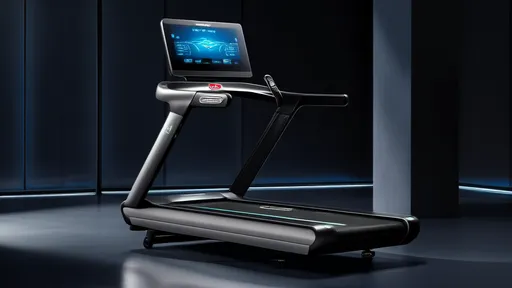
The science behind treadmill incline settings has evolved significantly in recent years, moving beyond generic recommendations to personalized calculations based on biomechanics and training goals. While most casual runners simply press the up/down arrows randomly, understanding the mathematical relationships between gradient, speed, and energy expenditure can transform your workout from mundane to precision-engineered.
Physiologists have identified three key variables that interact in treadmill incline formulas: the angle of elevation (θ), the runner's velocity (v), and the metabolic cost (METS). The fundamental equation relates these factors through trigonometric functions, where the additional workload compared to flat running approximates sinθ × body weight × distance. This explains why even slight inclines of 2-3% dramatically increase calorie burn without requiring speed adjustments.
What most runners don't realize is that the "optimal" incline differs between power walking and running gaits. At walking speeds below 4 mph, steeper inclines up to 15% activate glute muscles similarly to stair climbing, while runners maintaining 6+ mph speeds should limit incline to 7% maximum to avoid compromising form. The crossover point where incline becomes more metabolically demanding than speed increases occurs around 5% grade - beyond this, oxygen consumption rises exponentially rather than linearly.
The oft-cited "12-3-30" workout (12% incline, 3 mph, 30 minutes) gained viral popularity precisely because it leverages these physiological principles. However, research from the Journal of Sports Sciences reveals this formula works best for individuals weighing 60-75kg; heavier runners experience disproportionate knee stress, while lighter individuals may need adjusted parameters. This highlights the importance of weight-adjusted calculations rather than one-size-fits-all approaches.
Advanced runners incorporate periodized incline strategies using formulas accounting for VO2 max. For example, the Karvonen method modifies incline percentages based on heart rate reserve: [(HRmax - HRrest) × %intensity] + HRrest. When applied to incline training, this creates personalized "hills" that match cardiovascular capacity. Some smart treadmills now automate these calculations, dynamically adjusting incline to maintain exact metabolic targets throughout the workout.
Biomechanical studies reveal surprising nuances in incline running dynamics. Contrary to intuition, a 1% incline actually mimics outdoor running conditions better than completely flat treadmills, as it compensates for the lack of air resistance. Wind tunnel tests show this small adjustment brings oxygen consumption within 2% of overground running, making it a rare instance where scientific precision trumps subjective feel.
The interplay between incline and injury prevention follows a U-shaped curve. While moderate inclines of 3-5% reduce impact forces by 12-18% compared to flat running (per Clinical Biomechanics studies), excessive inclines above 8% increase Achilles tendon strain by up to 27%. Sports medicine specialists now recommend using the "5% rule" for recovery runs - keeping incline at half your normal training percentage to maintain form while reducing joint loading.
Emerging research on eccentric loading suggests alternating incline directions can produce unique training effects. Downhill running at -3% to -5% grade, though rarely programmed into treadmills, creates 22% greater muscle damage (and subsequent adaptation) than flat running according to European Journal of Applied Physiology data. Forward-thinking coaches now periodize both positive and negative gradients throughout training cycles.
The mathematics behind these calculations involve calculus concepts like partial derivatives to account for changing relationships between variables. For instance, the rate of calorie burn change per degree of incline isn't constant - it accelerates as incline increases. Modern algorithms solve these nonlinear equations in real-time, allowing today's treadmills to automatically adjust workouts second-by-second based on physiological feedback.
Looking ahead, the next frontier involves AI-driven incline optimization. Experimental systems now analyze thousands of data points including stride length, ground contact time, and vertical oscillation to prescribe micro-adjustments in incline throughout each stride cycle. This represents a quantum leap from static incline settings to dynamic, gait-adaptive resistance - essentially creating a "smart hill" that responds to the runner's biomechanics in real time.

By /Jul 28, 2025

By /Jul 28, 2025

By /Jul 28, 2025

By /Jul 28, 2025
By /Jul 28, 2025
By /Jul 28, 2025

By /Jul 28, 2025
By /Jul 21, 2025

By /Jul 28, 2025

By /Jul 28, 2025

By /Jul 28, 2025

By /Jul 28, 2025

By /Jul 28, 2025

By /Jul 28, 2025
By /Jul 28, 2025

By /Jul 28, 2025

By /Jul 28, 2025

By /Jul 28, 2025
By /Jul 28, 2025

By /Jul 28, 2025
